

Faculty of Law Journal

Department of Law Journal

Our Journal Website
02588864333 dean.law@ru.ac.bd
  • Submission
  • Apply Now
Faculty of Law Journal
  • HOME
  • About Journal
  • Current Issues
  • Aims and Objectives
  • Instruction for Authors
  • Notice Archive
  • Blog
  • Contact Us
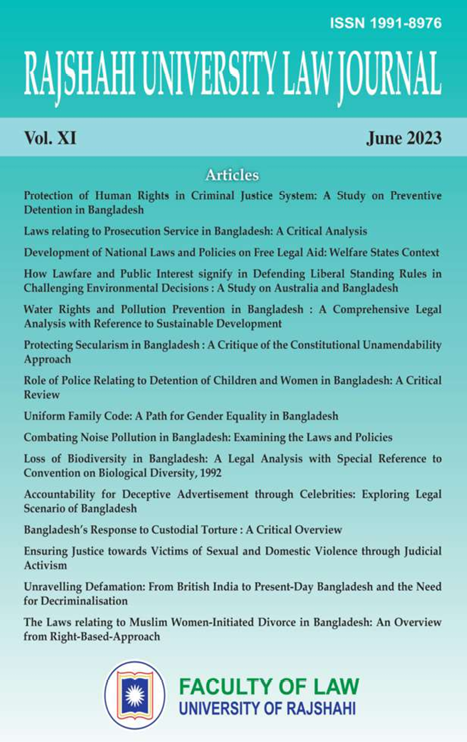
Uniform Family Code: A Path for Gender Equality in Bangladesh

- Uniform Family Code: A Path for Gender Equality in Bangladesh -

  • HOME
  • About Journal
  • Aims and Objectives
  • Call for Papers
  • Editor Panel
  • Board of Editors
  • Current Issue▸
    • LAW JOURNAL, VOL-11
    • LAW JOURNAL, VOL-10
    • LAW JOURNAL, VOL-9
    • LAW JOURNAL, VOL-8
    • LAW JOURNAL, VOL-7
    • LAW JOURNAL, VOL-6
    • LAW JOURNAL, VOL-5
    • LAW JOURNAL, VOL-4
    • LAW JOURNAL, VOL-3
    • LAW JOURNAL, VOL-2
    • LAW JOURNAL, VOL-1
  • Instruction for Authors
  • Notice Archive
  • Contact Us

Uniform Family Code: A Path for Gender Equality in Bangladesh

Punam Chakrabarty
Department of Law, Khulna University,

Debjyoti Sarkar
The USAID Ain Shohayota, Democracy International Inc,


Publish Date: September 10, 2023

DOI: #

Issue: 8

Page Number: 157-176

PDF: View PDF


Abstract

Bangladesh is a multi-religious and multi-racial country. The majority of the population consists of Muslims, Hindus, Buddhists Christians and some other minor communities. There are several indigenous tribes as well (i.e., Chakmas, Marmas, Tripuras, Garos, Santhals, Murong, Khasia, Kuki, Hazong etc.) living mostly in the hilly fringes of the Country. In absence of any Uniform Code of Family Laws, family disputes related to marriage, divorce, maintenance, custody of children, guardianship, inheritance etc. are dealt with under various Personal Laws. In addition to the Codified Personal Laws, many family disputes are resolved through local customs, practices and various methods of informal dispute resolution. This study has employed doctrinal methodology. To conduct this study several documents relating to family laws, cases and different article relating to this has been analyzed. This study finds how does the Uniform Family Code promote gender equality, women’s and children’s rights, and social cohesion, how a Uniform Family Code can promote gender equality, protect women and children, boost economic growth, and reduce social unrest having implementation issues, religious sentiments, and political opposition present challenges, despite its benefits. It also examines the challenges to implementing the Uniform Family Code in Bangladesh. This paper argues that gender equality for Bangladeshi women must transcend political and religious boundaries and the urgent need for a Uniform Family Code to achieve gender equality and social unity in Bangladesh’s diverse context.

← Previous: Role of Police Relating to Detention of Children and Women in Bangladesh: A Critical Review
Next: Combating Noise Pollution in Bangladesh: Examining the Laws and Policies →

About Us

This is an example page. It’s different from a blog post because it will stay in one place and will show up in your site navigation (in most themes). Most people start with an About page that introduces them to potential site visitors. It might say something like this: Hi there! I’m a bike messenger by day, aspiring actor by night, and this is my website. I live in Los Angeles, have a great dog named Jack, and I like piña coladas. (And gettin’ caught in the rain.) read more

Important Links

  • About US
  • Contact Us
  • Current Issues
  • Editorial Board
  • Submission Board
  • Journal Application
  • Bangladesh Journals
  • International Journals

Latest News

  • This is an example page. It’s different from a blog post because it will stay in one place and will show up in your site navigation September 2, 2025
  • Application for submission Article September 2, 2025
  • আবেদনের জন্য প্রয়োজনীয় কাগজ পত্র September 2, 2025

Follow us

  • Privacy Policy
  • Terms of Service
  • Refund and Returns Policy
  • Acceptable Use Policy (AUP)

All rights reserved © 2026, Faculty of Law Journal. Design & Developed by rajIT Solutions Ltd.