

Faculty of Law Journal

Department of Law Journal

Our Journal Website
02588864333 dean.law@ru.ac.bd
  • Submission
  • Apply Now
Faculty of Law Journal
  • HOME
  • About Journal
  • Current Issues
  • Aims and Objectives
  • Instruction for Authors
  • Notice Archive
  • Blog
  • Contact Us
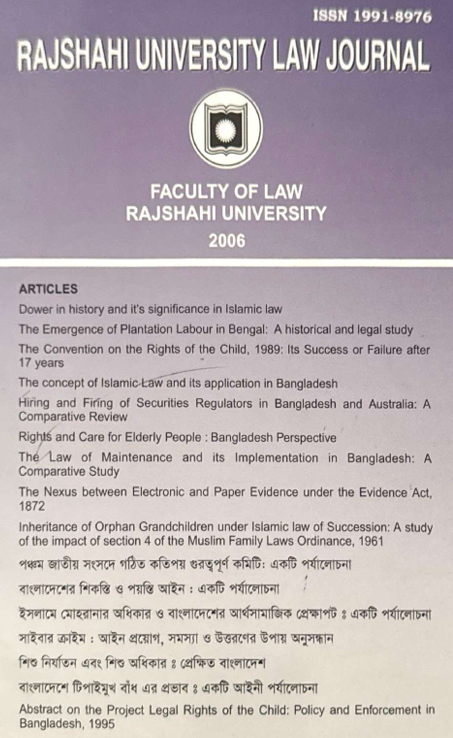
Dower in history and its significance in Islamic Law

- Dower in history and its significance in Islamic Law -

  • HOME
  • About Journal
  • Aims and Objectives
  • Call for Papers
  • Editor Panel
  • Board of Editors
  • Current Issue▸
    • LAW JOURNAL, VOL-11
    • LAW JOURNAL, VOL-10
    • LAW JOURNAL, VOL-9
    • LAW JOURNAL, VOL-8
    • LAW JOURNAL, VOL-7
    • LAW JOURNAL, VOL-6
    • LAW JOURNAL, VOL-5
    • LAW JOURNAL, VOL-4
    • LAW JOURNAL, VOL-3
    • LAW JOURNAL, VOL-2
    • LAW JOURNAL, VOL-1
  • Instruction for Authors
  • Notice Archive
  • Contact Us

Dower in history and its significance in Islamic Law

Dr. Begum Asma Siddiqua
Department of Law & Justise, RAJSHAHI UNIVERSITY,


Publish Date: August 25, 2006

DOI: #

Issue: 1

Page Number: 1-10

PDF: View PDF


Abstract

It is one of the most ancient traditions of the human family relations that at the time of marriage the man pays a dower (mehr) to the woman or to her father. In addition to that, he undertakes to bear the expenses of his wife and children during the entire period of his life. This practice in different forms is known to the people of the scriptures and also to many communities of the world. Dower used to be paid to the wife or widow in most of the European countries and even today some of the countries have retained this provision. In Islam payment of dower is obligatory on the husband to the wife. Dower, in Islam is a present given by husband to the wife as a sign of friendship, cordiality and goodwill. Dower in Islam is a free gift to the wife on which she can exercise her absolute right. This article does not address the Quranic provisions of dower in detail, kinds of dower as exist in traditional law and can be found in many text books, amount of dower coupled with the debate on dower and dowry as prevalent in Bangladeshi society. Those areas can be discussed independently on their own merit and an article in this issue appears on a different area of dower. Dower was prevalent among the Arabs in different forms which is also available in some text books and as such it has not been discussed in this article except for reference. This article aims to look at dower as it exists in history of the European and north American countries, history of dower as appears from the Quran, philosophy of dower and its significance in the Islamic system of marriage. The methodology adopted for this study is both descriptive and analytical.

← Previous: Protection of Human Rights in Criminal Justice: Bangladesh Perspective
Next: The Emergence of Plantation Labour in Bengal: A historical and legal study →

About Us

This is an example page. It’s different from a blog post because it will stay in one place and will show up in your site navigation (in most themes). Most people start with an About page that introduces them to potential site visitors. It might say something like this: Hi there! I’m a bike messenger by day, aspiring actor by night, and this is my website. I live in Los Angeles, have a great dog named Jack, and I like piña coladas. (And gettin’ caught in the rain.) read more

Important Links

  • About US
  • Contact Us
  • Current Issues
  • Editorial Board
  • Submission Board
  • Journal Application
  • Bangladesh Journals
  • International Journals

Latest News

  • This is an example page. It’s different from a blog post because it will stay in one place and will show up in your site navigation September 2, 2025
  • Application for submission Article September 2, 2025
  • আবেদনের জন্য প্রয়োজনীয় কাগজ পত্র September 2, 2025

Follow us

  • Privacy Policy
  • Terms of Service
  • Refund and Returns Policy
  • Acceptable Use Policy (AUP)

All rights reserved © 2026, Faculty of Law Journal. Design & Developed by rajIT Solutions Ltd.