

Faculty of Law Journal

Department of Law Journal

Our Journal Website
02588864333 dean.law@ru.ac.bd
  • Submission
  • Apply Now
Faculty of Law Journal
  • HOME
  • About Journal
  • Current Issues
  • Aims and Objectives
  • Instruction for Authors
  • Notice Archive
  • Blog
  • Contact Us
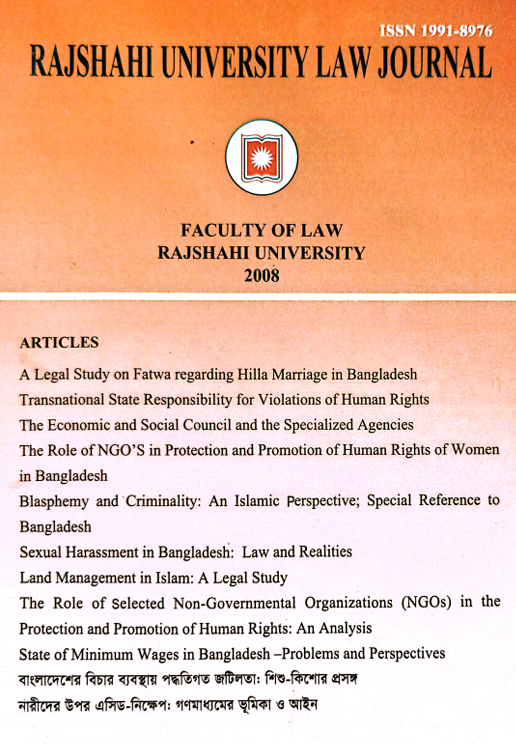
Transnational State Responsibility for Violations of Human Rights

- Transnational State Responsibility for Violations of Human Rights -

  • HOME
  • About Journal
  • Aims and Objectives
  • Call for Papers
  • Editor Panel
  • Board of Editors
  • Current Issue▸
    • LAW JOURNAL, VOL-11
    • LAW JOURNAL, VOL-10
    • LAW JOURNAL, VOL-9
    • LAW JOURNAL, VOL-8
    • LAW JOURNAL, VOL-7
    • LAW JOURNAL, VOL-6
    • LAW JOURNAL, VOL-5
    • LAW JOURNAL, VOL-4
    • LAW JOURNAL, VOL-3
    • LAW JOURNAL, VOL-2
    • LAW JOURNAL, VOL-1
  • Instruction for Authors
  • Notice Archive
  • Contact Us

Transnational State Responsibility for Violations of Human Rights

Dr. M Abdul Hannan
Department of Law & Justise, RAJSHAHI UNIVERSITY,


Publish Date: August 10, 2008

DOI: #

Issue: 2

Page Number: 15-54

PDF: View PDF


Abstract

International law is designed to make each state responsible for the human rights protection of its own population; this includes litigation for violations targeting another state. This text posits that broadening state responsibility to include violations of human rights in other states as well as towards citizens of other states is not only desirable and feasible, but also necessary.
This paper examines a paradox in international human rights law. Human rights are declared to be universal, yet state responsibility for their violations is limited by territoriality as well by citizenship. Each state is responsible for human rights violations occurring in its own territory. In contrast, state responsibilities with regard to citizens of other states are vague and weak. Individuals can claim and enforce rights against their own state (in theory, at least). However, non-resident non-citizens can only claim and enforce rights against other states through their own state.
Territoriality of law conflicts with the postulated universality of human rights because individuals cannot hold a state other than their own responsible for violating their rights; it is their taste that should hold another responsible. This, however, seldom happens. Either the state that intervenes does so because of inequality of power or a legal challenge involves a risk of retaliation that the previously victimized state can ill afford, or in order to promote the purposes and goals of the ruling government in this other country, but not necessarily the interests of the citizens of state.

← Previous: A Legal Study on Fatwa regarding Hilla Marriage in Bangladesh
Next: The Economic and Social Council and the Specialized Agencies →

About Us

This is an example page. It’s different from a blog post because it will stay in one place and will show up in your site navigation (in most themes). Most people start with an About page that introduces them to potential site visitors. It might say something like this: Hi there! I’m a bike messenger by day, aspiring actor by night, and this is my website. I live in Los Angeles, have a great dog named Jack, and I like piña coladas. (And gettin’ caught in the rain.) read more

Important Links

  • About US
  • Contact Us
  • Current Issues
  • Editorial Board
  • Submission Board
  • Journal Application
  • Bangladesh Journals
  • International Journals

Latest News

  • This is an example page. It’s different from a blog post because it will stay in one place and will show up in your site navigation September 2, 2025
  • Application for submission Article September 2, 2025
  • আবেদনের জন্য প্রয়োজনীয় কাগজ পত্র September 2, 2025

Follow us

  • Privacy Policy
  • Terms of Service
  • Refund and Returns Policy
  • Acceptable Use Policy (AUP)

All rights reserved © 2026, Faculty of Law Journal. Design & Developed by rajIT Solutions Ltd.