

Faculty of Law Journal

Department of Law Journal

Our Journal Website
02588864333 dean.law@ru.ac.bd
  • Submission
  • Apply Now
Faculty of Law Journal
  • HOME
  • About Journal
  • Current Issues
  • Aims and Objectives
  • Instruction for Authors
  • Notice Archive
  • Blog
  • Contact Us
How Lawfare and Public Interest signify in Defending Liberal Standing Rules in Challenging Environmental Decisions: A Study on Australia and Bangladesh

- How Lawfare and Public Interest signify in Defending Liberal Standing Rules in Challenging Environmental Decisions: A Study on Australia and Bangladesh -

  • HOME
  • About Journal
  • Aims and Objectives
  • Call for Papers
  • Editor Panel
  • Board of Editors
  • Current Issue▸
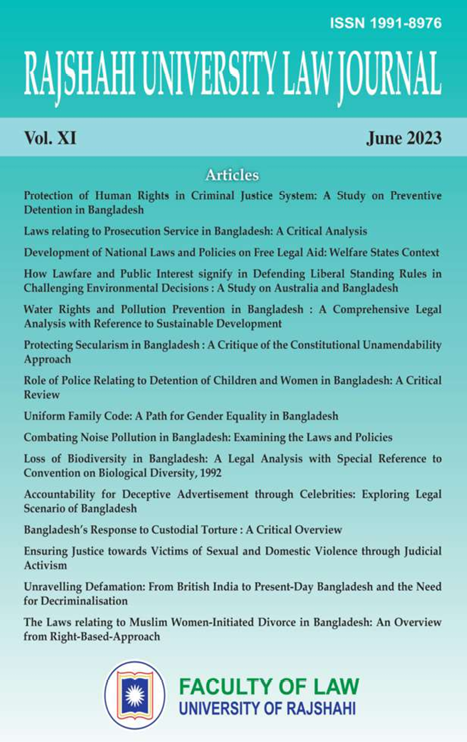
    • LAW JOURNAL, VOL-11
    • LAW JOURNAL, VOL-10
    • LAW JOURNAL, VOL-9
    • LAW JOURNAL, VOL-8
    • LAW JOURNAL, VOL-7
    • LAW JOURNAL, VOL-6
    • LAW JOURNAL, VOL-5
    • LAW JOURNAL, VOL-4
    • LAW JOURNAL, VOL-3
    • LAW JOURNAL, VOL-2
    • LAW JOURNAL, VOL-1
  • Instruction for Authors
  • Notice Archive
  • Contact Us

How Lawfare and Public Interest signify in Defending Liberal Standing Rules in Challenging Environmental Decisions: A Study on Australia and Bangladesh

Md Atiqur Rahman
Joint District And Sessions Judge, Government Of The People's Republic Of Bangladesh,

Md. Mahfuzur Rahman
Department of Law, RAJSHAHI UNIVERSITY,


Publish Date: September 10, 2023

DOI: #

Issue: 4

Page Number: 67-90

PDF: View PDF


Abstract

Both Australia and Bangladesh have judicial systems that allow for the judicial review of government decisions on environmental issues. The fundamental distinction between the jurisdictions is that in Australia, statutes confer upon courts the power of judicial review to justify executive actions relating to environment. Conversely, no statute proffers the power of judicial review upon the Bangladeshi courts to validate government decisions pertaining to environment. Courts in both countries primarily hinge upon the standing rules that control who is permitted to present an application before courts when it comes to the practice of the power of judicial review, stressing that the aggrieved person should have locus standi. This study analyzes the way to understand how courts in both jurisdictions expand standing rules in justifying executive decision on environmental issues contributing to advance public interest rather than incite lawfare. The central hypothesis of this study is that the liberal interpretation of standing rules serves the purpose of providing systematic and crucial information to the government aims to hold decision-makers accountable for making judgments on matters of national environmental significance. Ultimately, this safeguards public interest instead of triggering lawfare.

← Previous: Development of National Laws and Policies on Free Legal Aid: Welfare States Context
Next: Water Rights and Pollution Prevention in Bangladesh: A Comprehensive Legal Analysis with Reference to Sustainable Development →

About Us

This is an example page. It’s different from a blog post because it will stay in one place and will show up in your site navigation (in most themes). Most people start with an About page that introduces them to potential site visitors. It might say something like this: Hi there! I’m a bike messenger by day, aspiring actor by night, and this is my website. I live in Los Angeles, have a great dog named Jack, and I like piña coladas. (And gettin’ caught in the rain.) read more

Important Links

  • About US
  • Contact Us
  • Current Issues
  • Editorial Board
  • Submission Board
  • Journal Application
  • Bangladesh Journals
  • International Journals

Latest News

  • This is an example page. It’s different from a blog post because it will stay in one place and will show up in your site navigation September 2, 2025
  • Application for submission Article September 2, 2025
  • আবেদনের জন্য প্রয়োজনীয় কাগজ পত্র September 2, 2025

Follow us

  • Privacy Policy
  • Terms of Service
  • Refund and Returns Policy
  • Acceptable Use Policy (AUP)

All rights reserved © 2026, Faculty of Law Journal. Design & Developed by rajIT Solutions Ltd.