

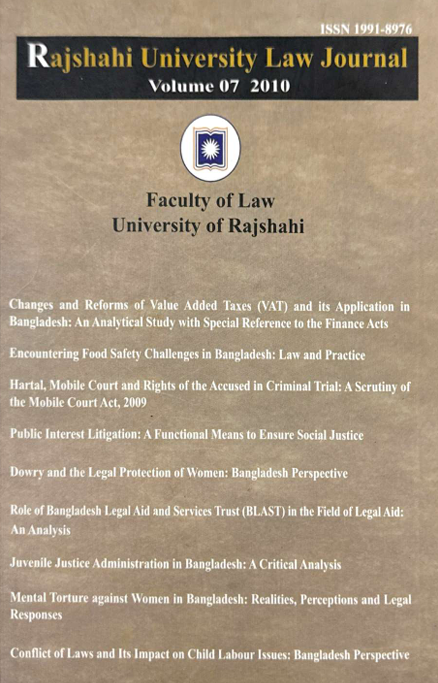
Abstract
In the present legal systems of most Asian and African States, justice is not so easily obtainable. The consumers of justice have to pay fees of advocates, bear costs incurred on witnesses and also other incidental charges. Indeed, especially in the developing and third world countries, poverty is a major barrier on the way of getting justice; and due to this reason the poor becomes sufferer of social prejudice. Incoherent legal procedure, prohibitive costs of litigation and excessive delay are some prohibitive obstacles in the case of access to justice for the vulnerable section of society. Legal aid is a strong means of securing access to justice for all. Without providing legal aid to the vulnerable section of society, access to justice for all is completely meaningless. So legal aid as one of the significant policy of affording access to justice has now been widely recognized in many countries. Legal aid is really related to broader notion of social justice and its realization depends upon appropriate legal arrangement, sound institutional framework and coordinated efforts of state apparatus and civil society. The role of our State in providing legal aid for litigation is, however, insufficient to the needs of the poor. In the situation of unfulfilling demand for indispensable legal aid, BLAST has taken upon itself the task, as far as possible, of making the judicial system accessible to the poor and the marginalized by delivering legal aid. The main objectives of this article are to analyze different definitions of legal aid, relation between human rights and legal aid, forms and procedure of BLAST’s legal aid, success of BLAST’s legal aid, and existing state of legal aid operated by Bangladeshi government and its relation with BLAST.