

Faculty of Law Journal

Department of Law Journal

Our Journal Website
02588864333 dean.law@ru.ac.bd
  • Submission
  • Apply Now
Faculty of Law Journal
  • HOME
  • About Journal
  • Current Issues
  • Aims and Objectives
  • Instruction for Authors
  • Notice Archive
  • Blog
  • Contact Us
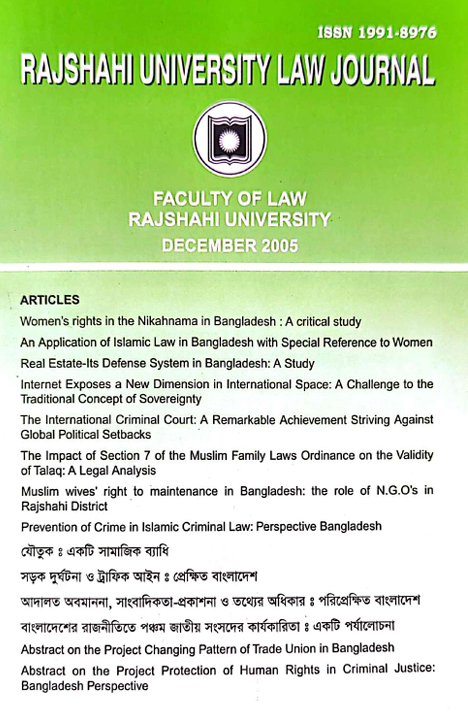
The Impact of Section 7 of the Muslim Family Laws Ordinance on the Validity of Talaq: A Legal Analysis

- The Impact of Section 7 of the Muslim Family Laws Ordinance on the Validity of Talaq: A Legal Analysis -

  • HOME
  • About Journal
  • Aims and Objectives
  • Call for Papers
  • Editor Panel
  • Board of Editors
  • Current Issue▸
    • LAW JOURNAL, VOL-11
    • LAW JOURNAL, VOL-10
    • LAW JOURNAL, VOL-9
    • LAW JOURNAL, VOL-8
    • LAW JOURNAL, VOL-7
    • LAW JOURNAL, VOL-6
    • LAW JOURNAL, VOL-5
    • LAW JOURNAL, VOL-4
    • LAW JOURNAL, VOL-3
    • LAW JOURNAL, VOL-2
    • LAW JOURNAL, VOL-1
  • Instruction for Authors
  • Notice Archive
  • Contact Us

The Impact of Section 7 of the Muslim Family Laws Ordinance on the Validity of Talaq: A Legal Analysis

Muhammad Ekramul Haque
Department of Law, DHAKA UNIVERSITY,


Publish Date: August 11, 2005

DOI: #

Issue: 6

Page Number: 69-86

PDF: View PDF


Abstract

Unlike many other religious legal systems Islamic law considers marriage as a contract though there are some differences with the concept of civil contract strictly speaking. It also accommodates a scope to terminate a contract in a number of ways. Thus, Islamic sharia law prescribes certain specific procedures to terminate a marriage. It may be terminated by acts of the parties, by death or by operation of law. Apart from unilateral termination to be made by the husband or by the wife being empowered by delegated power of divorce there is also a scope to dissolve a marriage through mutual consent. In whatever method a marriage is dissolved the sharia law nowhere requires any notification to be made to any formal authority expressly in this regard. But, many countries by legislation added some statutory formalities to be observed to terminate a marriage even under Islamic law. The status of those statutes sometimes seems to be obscure for want of clear provision regarding its observance and consequence of its non-observance. Muslim Family Laws Ordinance, 1961 is one such legislation that is now applicable in Bangladesh that lays down certain procedural formalities to be observed to pronounce a talaq in whatever mode, inter alia, section 7(1) of this Ordinance prescribes a talaq to be notified to the Chairman, a local government authority who in turn will take certain steps to conciliate the dispute and after the expiry of 90 days on and from the day of receipt of notification’ by tile Chairman talaq will become effective. It is also mentioned in section 7 that non-observance of such

← Previous: The International Criminal Court: A Remarkable Achievement Striving against Global Political Setbacks
Next: Muslim wives’ right to maintenance in Bangladesh: the role of N.G.O’s in Rajshahi District →

About Us

This is an example page. It’s different from a blog post because it will stay in one place and will show up in your site navigation (in most themes). Most people start with an About page that introduces them to potential site visitors. It might say something like this: Hi there! I’m a bike messenger by day, aspiring actor by night, and this is my website. I live in Los Angeles, have a great dog named Jack, and I like piña coladas. (And gettin’ caught in the rain.) read more

Important Links

  • About US
  • Contact Us
  • Current Issues
  • Editorial Board
  • Submission Board
  • Journal Application
  • Bangladesh Journals
  • International Journals

Latest News

  • This is an example page. It’s different from a blog post because it will stay in one place and will show up in your site navigation September 2, 2025
  • Application for submission Article September 2, 2025
  • আবেদনের জন্য প্রয়োজনীয় কাগজ পত্র September 2, 2025

Follow us

  • Privacy Policy
  • Terms of Service
  • Refund and Returns Policy
  • Acceptable Use Policy (AUP)

All rights reserved © 2026, Faculty of Law Journal. Design & Developed by rajIT Solutions Ltd.