

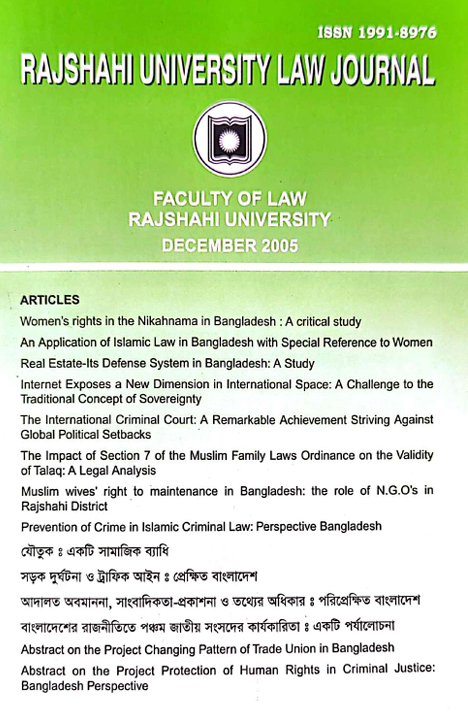
Abstract
The connotation ‘Sovereignty’ varies from man to man, time to time and state to state. But it has a core meaning, which signifies supreme authority within a territory. It is a modem notion of political authority. Sovereignty of state comprises of two-fold capacity; such as. Imperium and dominium covering almost all functions of a state. Imperium indicates state authority over the state territory and dominium upholds the unlimited state control over the persons, institutions and events within its territory. Cyberspace crosses the border. So it is difficult for a state to apply territorial authority on it. A state cannot achieve physical control over cyber activities, because, these activities are not confined within the territory. These go outside the territory, and very often enter into the territory of any state without any physical restriction. This is really a problem for the state habituated to the territory-based sovereignty. The underlying causes of the problem are:- (1) the peculiar structure of the internet; (2) non-physical character of the cyber activities; and (3) everywhere and nowhere location of cyberspace. External aspects of sovereignty indicate a state’s freedom from outside influence upon its basic prerogatives. But the omnipresence character of internet made it accessible from anywhere in the world that deriding international principles-territorial integrity, political independence and domestic affairs. A final ingredient of sovereignty is territoriality. It specifies a geographic